From AI-Driven Creativity to Sustainable and Inclusive Education: Interdisciplinary Approaches to Technology, Diversity, and Lifelong Learning in the Digital Era
DOI:
https://doi.org/10.65222/VIRAL.2026.4.25.45Keywords:
Abstract
The rapid expansion of artificial intelligence and emerging digital technologies has transformed contemporary understandings of creativity, education, and social inclusion. Educational institutions increasingly confront the challenge of integrating technological innovation while simultaneously preserving diversity, accessibility, and human-centered learning practices. This paper examines the intersection between AI-driven creativity, sustainable education, and inclusive learning ecosystems within the broader context of digital transformation. Drawing on interdisciplinary perspectives from educational technology, creative studies, sustainability research, and lifelong learning theory, the study explores how AI-supported systems influence pedagogical innovation, artistic expression, collaborative learning, and competence development across diverse educational settings. Particular attention is given to the role of emerging technologies in supporting inclusive educational participation, reducing barriers to learning, and promoting adaptive lifelong learning environments. The analysis also addresses ethical concerns related to digital inequality, technological dependency, and the evolving relationship between human creativity and algorithmic systems. The paper argues that sustainable educational transformation requires balancing technological advancement with social responsibility, diversity, and equitable access to knowledge. Ultimately, the study contributes to current debates regarding the future of education in digitally mediated societies by proposing a human-centered framework for integrating creativity, sustainability, and intelligent technologies.
Downloads
References
[1] C. J. Johnstone, M. J. Schuelka, and G. Swadek, “Quality education for all? The promises and limitations of the SDG framework for inclusive education and students with disabilities,” in Grading Goal Four, Brill, 2020, pp. 96–115.
[2] D. Padua, “Artificial intelligence and quality education: The need for digital culture in teaching,” Journal of Educational, Cultural and Psychological Studies, no. 30, pp. 181–193, 2025.
[3] A. Samadhiya, A. Kumar, E. Mulat-Weldemeskel, S. Luthra, J. A. Garza-Reyes, and S. Yadav, “Next-gen quality learning: How can AI technologies shape education 4.0 and 5.0 towards the SDGs from multiple stakeholders' perspective?,” The TQM Journal, vol. 38, no. 4, pp. 806–834, 2026.
[4] B. J. Jackson and L. Brown-Robertson, “Utilizing virtual and augmented reality to enhance real-world soft skills for socioeconomic advancement,” in Transformative Cloud Computing, IoT and Extended Reality, Cham: Springer Nature Switzerland, 2026, pp. 53–70.
[5] P. Caratozzolo, G. M. Chans, and A. Dominguez, “Continuing engineering education for a sustainable future,” Frontiers in Education, vol. 10, Article 1629507, 2025.
[6] N. V. Liando, D. P. Tatipang, J. N. Budiman, N. N. Ganap, and F. Lengkoan, “AI-driven educational interventions: Harnessing artificial intelligent to foster lifelong learning (a systematic investigation),” Lingua Scientia, vol. 32, no. 1, pp. 21–32, 2025.
[7] L. Arango-Vasquez, “Education in the digital age: Ethical and inclusive information technologies,” in World Conference on Information Systems and Technologies, Cham: Springer Nature Switzerland, 2025, pp. 43–57.
[8] D. Mariyono, A. N. A. Hidayatullah, and A. N. A. Kamila, “Integrating artificial intelligence in inclusive leadership: Transforming educational management for a globalized future,” 2024.
[9] D. Mariyono, M. Yunus, J. Junaidi, N. Syam, and Z. Mazhabi, “Educational leadership in the digital era: Bridging global disparities with inclusive management strategies,” Educational Management Administration & Leadership, 2026.
[10] R. Vettriselvan, “Empowering digital education: The future of value-based learning in the digital era,” in Empowering Value Co-Creation in the Digital Era, IGI Global Scientific Publishing, 2025, pp. 199–228.
[11] M. Prabu and B. C. Devi, “Sustainable education and its role in technology and the AI era,” in Toward Sustainable Environmental Education, Apple Academic Press, 2026, pp. 77–99.
[12] O. O. Kayode, A. D. Gbigbadua, R. Sulyman, M. B. Bello, S. Lawal, and S. T. Bakinde, “An exploratory study of artificial intelligence in promoting creative and sustainable science education,” TWIST, vol. 21, no. 1, pp. 222–227, 2026.
Downloads
Published
Issue
Section
License
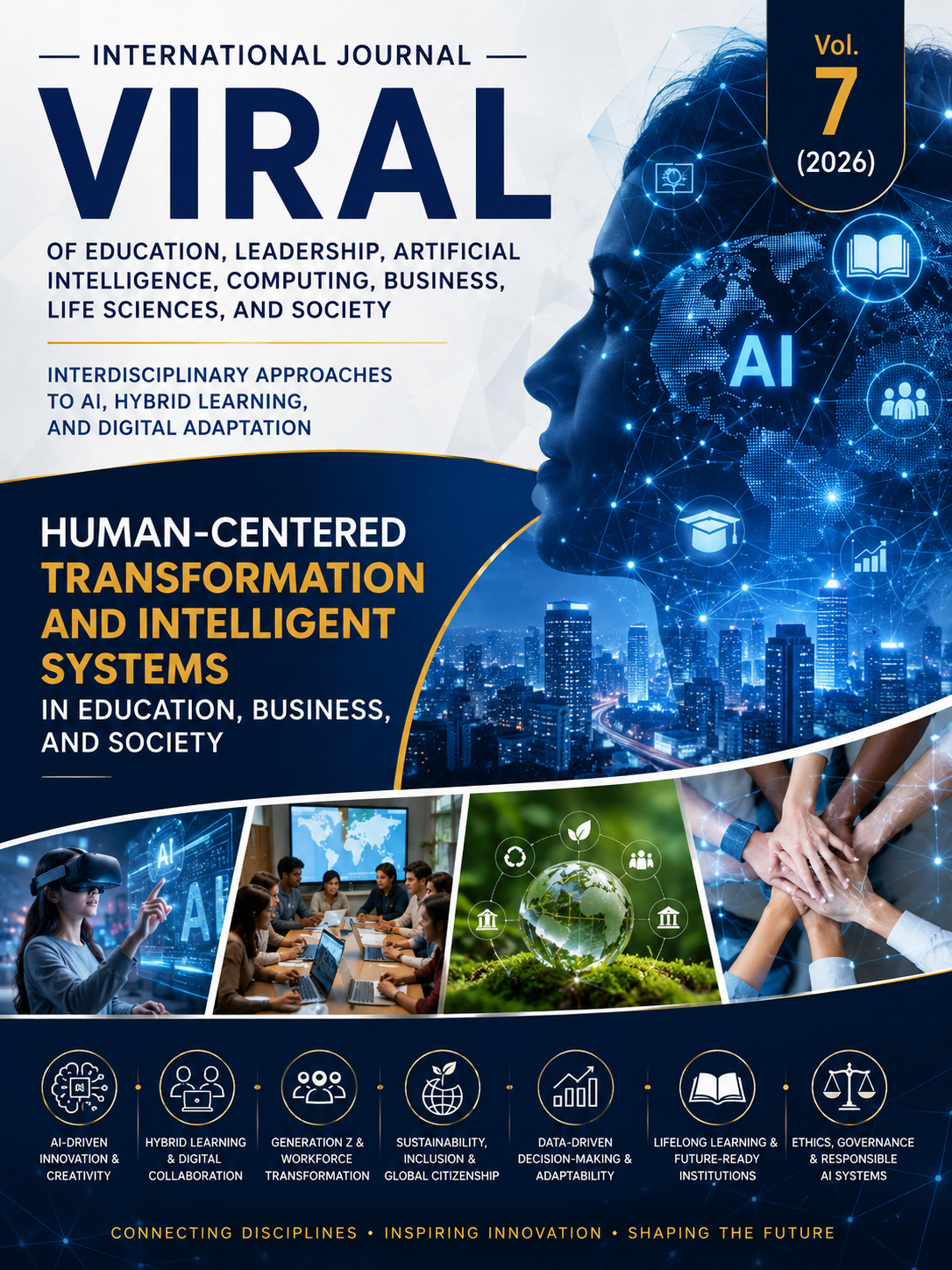
Copyright (c) 2026 International Journal of Education, Leadership, Artificial Intelligence, Computing, Business, Life Sciences, and Society

This work is licensed under a Creative Commons Attribution-NonCommercial-NoDerivatives 4.0 International License.